












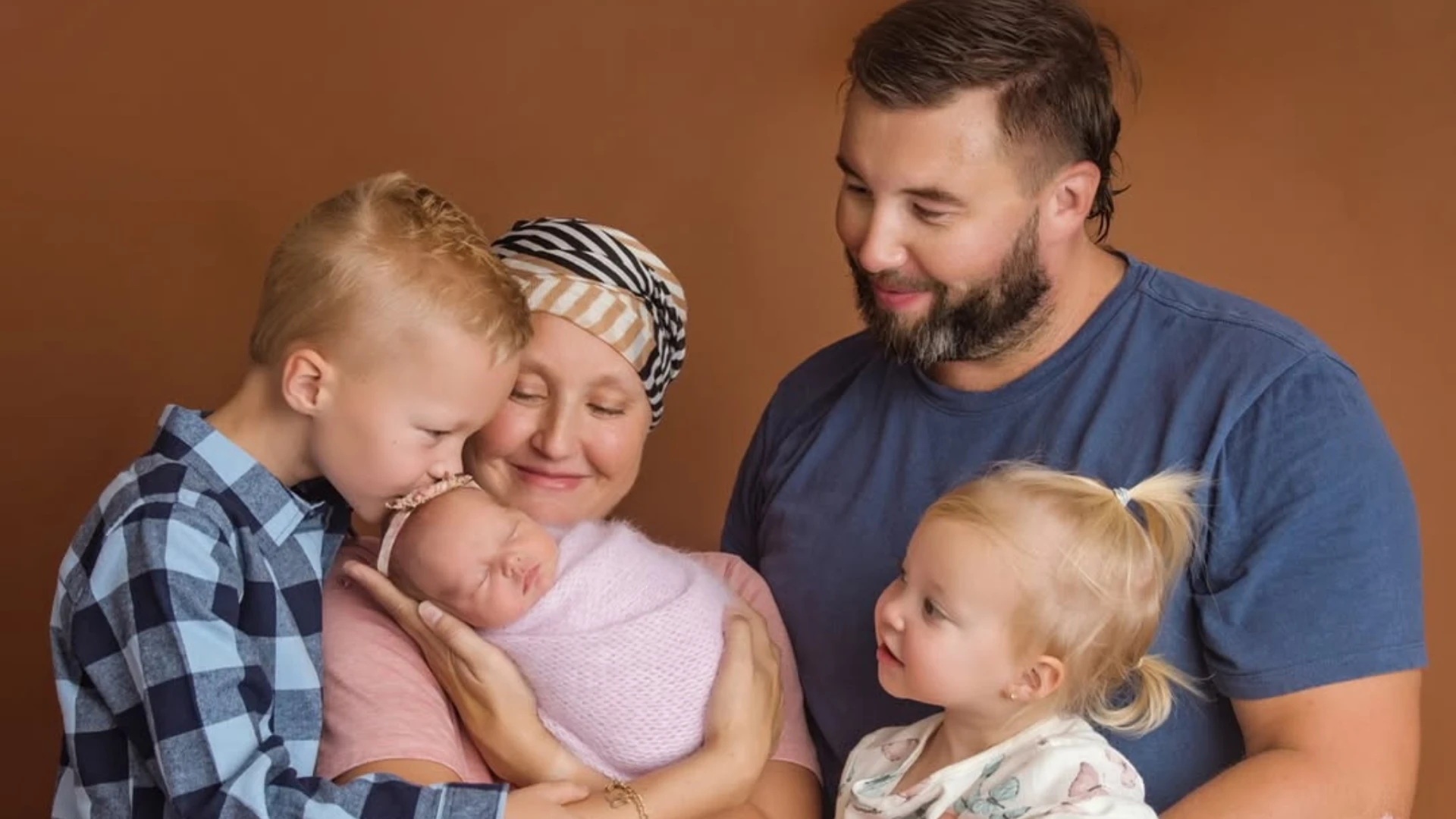

When Kriss Hardman, 37, found a lump in his testicle in 2020, his wife Kate had already survived breast cancer once. That experience meant he didn’t wait to see a doctor. Here, the Darwin father of three — Kian, 9, Kacia, 4 and Kaia, 2 — talks about his testicular cancer diagnosis, Kate’s stage four recurrence, the toll it took on his mental health and what finally turned it around.
Kate felt a lump while breastfeeding our firstborn, Kian, who was about six months old. We’re from the UK and we were actually back there at the time visiting family. We ended up staying a year while she underwent surgeries, radiation, various treatments and reconstructive surgery. She was 32. I was about 28. You’re young, you’re starting a new family, everything’s ticking along and then this hits you in the face.
It was early-stage breast cancer, very treatable. We returned to Australia in early 2019 and she continued with treatment and then monitoring.
Then in 2020, I felt a lump in my right testicle.
I don’t think I would have gone to the doctor as quickly as I did had Kate not been through cancer a couple of years prior. So many men I’ve read about and spoken to personally don’t — because of the embarrassment, the fear, whatever reason it might be. But something wasn’t right, and it was the nudge from her and the nudge from myself too: come on, let’s not stuff around, let’s go and get this squared away, whatever it is.
When you find something like that, you’re obviously hoping it’s not what you think it is. You’re jumping on Google, looking at things that are totally unhelpful, trying to put it down to anything else. My heart of hearts told me that it wasn’t something minor. It was painful and it wasn’t right.
So I was off to the GP. He said he couldn’t feel what I was feeling, but he took my word for it and did an urgent referral for an ultrasound. What they found was tiny — 0.6 of a centimetre. But it was testicular cancer.
“Going as quickly as I did was absolutely the right thing to do.”
– Name here
My treatment was just the surgery and monitoring afterwards: scans every six months for two years, checking my torso and lymph nodes. Everything came back clear.
I remember at the time just feeling sorry for myself. Me and Kate had a young kid and wanted to have more, which we’ve now got. But you think, geez, what chances have the kids got if mum and dad have both had cancer in their early thirties? You feel almost guilty for even thinking that. And then you’re anxious about your own diagnosis on top of worrying about your partner. There are all these mixed emotions that add to everything. It’s not just the diagnosis — it’s everything around it. In my experience, the mental health side of things had more of a negative impact than the actual diagnosis itself.

Kate’s recurrence
After I was given the all-clear, we decided to have a third child. Kate fell pregnant with Kaia. And during that pregnancy, at 22 weeks, Kate was diagnosed with a recurrence — this time bilaterally. It was in both breasts, even though she’d had a mastectomy on one side, and it was in her lymph nodes too.
Because there’s no ethical way of scanning a pregnant woman, the approach was to treat what they knew was there. They did surgery — all while she was 23, 24 weeks pregnant. She started chemotherapy during the pregnancy too, lost all her hair, and actually didn’t feel too unwell. But it was horrible, and the uncertainty of where else it might have spread was the hardest part.
Then she developed neck pain that kept getting worse until I said, look, we’re going to ED, this is enough. They discovered she’d fractured her C5 — the cancer had metastasised to her spine. It was a stage four metastatic diagnosis. The one that no one wants. The one considered incurable.
You’ve got a little life inside her, weeks from being due. You’ve already got two other kids at home.
“ Everything hits you like a ton of bricks. Pretty much being told your wife isn’t going to be here for very long and you’re going to be it for your three kids — I didn’t get my head around it, to be honest.”
– Name here
Unhealthy coping
I coped in really poor ways. I was drinking every day — two bottles of wine or ten beers — just to numb it and get myself to sleep. But the sleep I was getting was awful and I was making myself really unwell. I gained around 35 kilograms. I was 145 kilograms. I’d played a lot of rugby in the past and I wasn’t doing any of it. I lost all motivation to do anything. I became very antisocial. It wasn’t the sort of drinking where you’re down the pub with the lads — it was very much at home, doing it just to knock myself out.
The light bulb moment came from a really good friend of mine — someone who isn’t afraid to speak up and say it how it is. He said: “If you carry on the way you’re going, you’re gonna end up going the same way as your missus.” That sounds really harsh when you say it out loud, but it’s exactly right. He said you’ve got to think that she probably isn’t going to be here in a few years’ time — if you send yourself the same way, who’s going to look after your kids?
That was all it was. No one had actually told me as it is. I think people either weren’t brave enough or didn’t have the awareness, because you become very good at hiding these things. You don’t draw attention to the fact that you’re not coping, because you’re a bloke and you’re too proud and you don’t want to put that out there.
I tried counselling through work — it just wasn’t for me. I’d go in against it from the start and walk out more angry than I’d walked in. What works for some might not work for others and you’ve just got to find what works for you.
“For me it was the slap in the face from a mate and having a support network of decent friends around me. It doesn’t change the diagnosis or the position the family’s in, but it changed my ability to be a better person for my family now and going forward.”
– Name here
I’ve been off the drink now for the last year. I’ve lost 26 kilos. I can’t tell you how much better I feel.
Kate is currently living with metastatic breast cancer. Treatment is keeping her scans clear and she’s staying positive, dealing with things when they happen. We’ve decided to share our family’s story on social media because if it can help just one person, it’s worth it.

Getting it sorted
My advice to anyone who’s putting off going to the doctor: by not going, you could lose everything. The bad news is going to come eventually and if you put it off, it could be even worse. No one wants to pull their pants down and show a doctor what’s going on, but that doctor’s seen it thousands of times and they just want to have a look and treat you. Go as quickly as you can.
And sometimes you’ve got to stand up for yourself, even with medical professionals. My GP couldn’t feel what I was feeling, but he took my word for it and referred me. Had he not done that and I’d put it off another six or eight weeks, it could have been a very different story. Testicular cancer can get out of control really quite quickly.
Whether it’s something you felt down there, or something going on in your head — as long as you seek help in a healthy way, that’s a positive step.

Related articles

Cyst vs cancer: What’s that lump on your testicle?
Read article
What your testicles should feel like and how to check if they’re healthy
Read article
Comedian Nick Capper on cracking jokes about testicular cancer
Read article